The alternatives to Sepilok, appraised
Updated Sept 2026 details verified
Type 'places to see orangutans' and a mixed crowd answers: genuine rehabilitation centres, feeding stations, trek villages, a lake island, and operations best described as ape entertainment. Here's each one honestly — and the two questions that sort them in under a minute.
The two sorting questions
Carry these everywhere; they outperform any review site.
One: can visitors touch, hold, feed or take selfies with the orangutans? If yes — walk away, whatever the signboard says about sanctuary. Contact spreads disease and destroys rehabilitation; a place selling it has priced the animals' futures into the ticket. The full argument.
Two: where do the animals end up? Real rehabilitation has releases to point to — Sepilok's hundred-plus. A "sanctuary" whose residents only ever accumulate is a collection with better vocabulary.
In Malaysia
Semenggoh Nature Reserve (Sarawak) — the genuine article: a feeding station for a semi-wild population, half an hour from Kuching, raw and brief and occasionally theatrical. Passes both questions comfortably. The full head-to-head.
Matang Wildlife Centre (Sarawak) — rescue and rehabilitation near Kuching with a grittier, enclosure-forward visit: animals mid-recovery, less polish, honest work visible. Worthwhile for travellers who want the unvarnished version; expect it to feel more shelter than showcase.
Bukit Merah Orang Utan Island (Perak) — the peninsula's lake-island facility, and note the geography: not Borneo, no wild population. A captive conservation and research operation — legitimate as what it is, provided you arrive knowing you're visiting managed enclosures, not forest.
Beyond Malaysia
Tanjung Puting (Kalimantan) and Bukit Lawang (Sumatra) are the two serious international alternatives — the klotok riverboat genre and the jungle-trek genre respectively, both covered properly in the islands comparison. Tanjung Puting's station model passes the questions cleanly; Bukit Lawang passes or fails by guide, which is the whole caution in four words.
Zoos and wildlife parks worldwide — a different thing entirely: conservation breeding and education at their best, ape display at their worst, and never a substitute for either island. If a zoo visit sparks the real trip, it did its job.
The pattern, once you see it
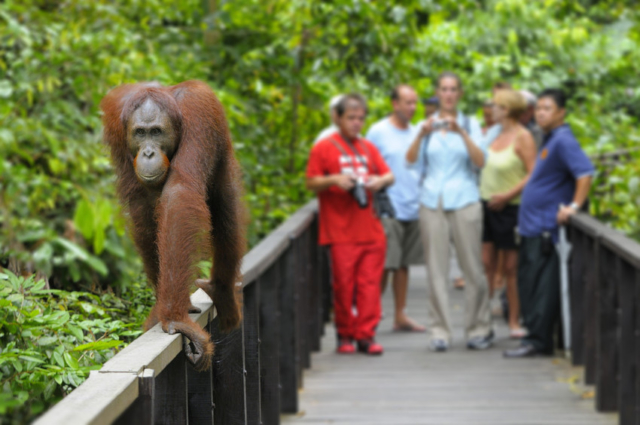
Every genuine operation on this page shares Sepilok's defining inconvenience: they keep you at a distance, promise you nothing, and measure success by animals leaving. Every dubious one inverts all three — closeness sold, encounters guaranteed, residents permanent. Sepilok isn't the only good answer to "where should I see orangutans?" But it is the yardstick the others get measured against — which is, quietly, its own answer.
Alternatives questions
Is there anywhere better than Sepilok?
Different, yes — Danum for wildness, Tanjung Puting for slow travel. "Better" at the combination of certainty, ethics, access and story: nothing yet. The ranking.
Are orangutan encounters in Thailand or Bali legitimate?
Orangutans aren't native to either — any there are captive, and shows or photo sessions with them fail question one instantly. Spend the money on the islands the species actually lives on.
What about volunteering as an alternative to visiting?
It's a deepening, not an alternative — and it comes with its own honesty check about contact expectations. What volunteering really involves.