The outdoor nursery
Updated Sept 2026 details verified
A young orangutan is halfway along a rope when its grip goes. It drops to the netting, sits up with the affronted dignity of a toddler, and starts again. This happens forty times a day, and it's the most important classroom in Borneo.
Through the glass
The viewing room is dim and blessedly cool — one of the two is air-conditioned — and the window fills with forest edge: a big climbing frame of ropes, poles and platforms with the real canopy rising behind it.
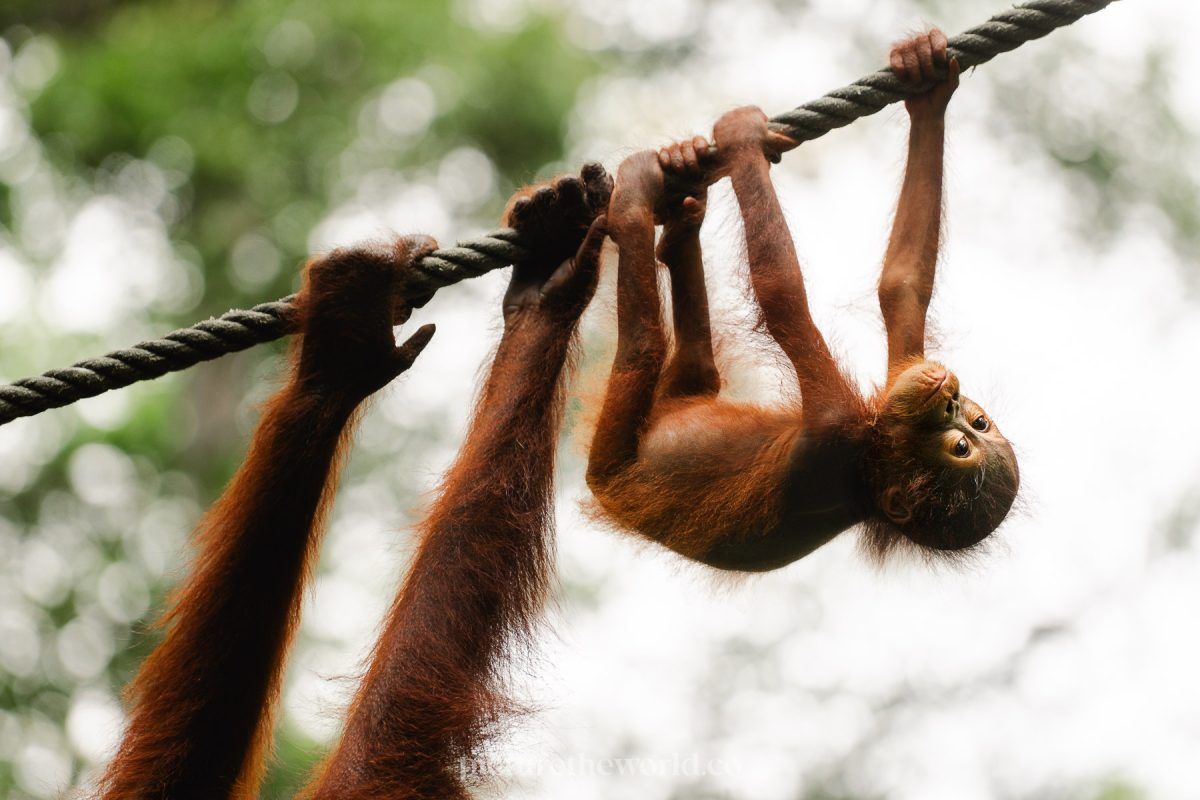
On the frame, the students. Young orphans, hauling themselves up things, swinging at things, missing, falling into the netting, trying again. Two wrestle over the same rope with an entire jungle gym of unoccupied ropes around them. One hangs upside down by a single foot, apparently for the principle of it.
It looks like play. It's the curriculum. Every fall into that netting is a fall the forest would have made fatal, taken now, on credit, while the stakes are soft.
What this place is
Opened in 2014, the outdoor nursery is the visible middle of the rehabilitation pipeline. Before it: the clinic and indoor nurseries, off-limits, where new arrivals recover and the youngest orphans are paired up to learn from each other. After it: the forest itself, and the platform's slowly loosening safety net.
Here in the middle, the physical education happens. A wild orangutan spends seven or eight years learning the canopy from its mother — grip, judgement, route-finding, nerve. An orphan has to assemble that education from keepers, peers and this frame. The glass matters as much as the equipment: it keeps human noise and human germs on your side, so the students bond with each other and the forest rather than with the audience. Why that boundary is absolute.
Why the nursery rarely disappoints
The platform's attendance depends on free adults choosing to visit, which the whole system discourages. The nursery's residents, by contrast, are in residence — too young to forage the reserve, on site by definition, and active through most of the day. That's the simple arithmetic behind this site's steadiest claim: on a day the platform runs quiet, the nursery is where the trip gets repaid.
It's also, quietly, the better show. The platform gives you orangutans eating. The nursery gives you orangutans becoming — effort, failure, persistence, personality. Visitors come for the first and leave talking about the second.
Making the most of it
- When: open through normal visiting hours, covered by the standard ticket. Mid-morning — after the 10:00 feeding, before the midday close — tends to be lively, and pairs naturally with the platform in the full-day shape.
- How long: give it a real half hour, not a walk-through. The behaviour unfolds; the wrestling match has acts.
- Photography: no flash, ever — and shoot at a slight angle to the glass to kill reflections. The nursery is where the frame-filling portraits live on quiet platform days.
- Manners at the window: quiet voices, no tapping, no phone against the glass. They can see you. The point is that they learn not to care.
- With kids: this is the station children remember — students their own emotional age — and the AC room doubles as the family recovery zone. The family guide.
Nursery questions
Can you see baby orangutans at Sepilok?
Yes — the outdoor nursery is exactly that: the young orphans' training ground, viewable through glass during opening hours. The very youngest arrivals are in off-limits indoor care until they're ready for it.
Is the nursery included in the ticket?
Yes — one ticket covers platform, nursery and boardwalk, all day, both sessions.
What time is the nursery most active?
It runs on the orphans' energy rather than a schedule; mid-morning and mid-afternoon are dependably busy. There's no feeding-time equivalent to plan around — just go.
Why can't visitors get closer than the glass?
Disease and habituation — the two things that end rehabilitations. The glass is why the nursery can exist as a public window at all. The rules, argued properly.