Are sightings guaranteed? No. Here's the whole truth.
Updated Sept 2026 details verified
Somewhere right now, an operator is promising someone guaranteed orangutans. The centre itself would never say it. This page is the version you'd get from a ranger over coffee — the real odds, what moves them, and why a quiet platform is a strange kind of good news.
The morning it happens to you
Picture it, because it might be your morning. 10:00 comes. The rangers lay the food. The ropes stay slack.
Ten minutes. Twenty. The macaques annex the bananas. Somewhere behind you a man mutters that he flew eleven hours for this.
Here's what that man doesn't know, and you're about to.
Why there is no guarantee — by design
Sepilok's residents are semi-wild. Not captive, not tame — free animals living in 4,294 hectares of forest, who may visit a feeding platform if the platform beats their other options.
And the centre works hard to make sure it usually doesn't. The platform serves the same two things every day, milk and bananas, precisely so that wild fruit wins. An orangutan that stops coming has graduated. The whole institution is a machine for making itself unnecessary, one no-show at a time.
So "are sightings guaranteed?" has only one honest answer: no — and if you ever find a facility where they are, ask hard questions about what's being done to those animals to make them so reliable.
The honest odds
The centre publishes no attendance statistics, and neither will we invent any. What we can tell you is how the odds move:
- Most sessions see orangutans. A completely empty platform is the exception, not the rule — but it's a real exception, concentrated in heavy fruiting periods.
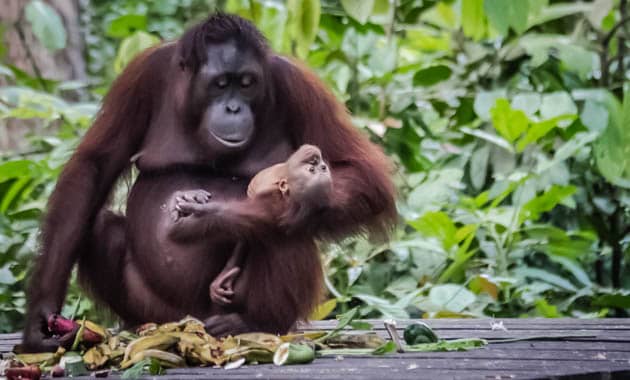
- The nursery is the near-certainty. The young orphans are in residence, practising on the climbing frame through the day. If your definition of success is "watched orangutans being orangutans," the nursery delivers it almost regardless of the platform's mood.
- Morning beats afternoon, most months, for turnout at the platform.
- The hungry season beats the fruiting season. November to February, when the forest's larder thins, platform attendance climbs. The full month-by-month picture: best time to visit.
- Two sessions beat one. Your ticket covers both feedings. That's two independent draws in one day, and it's free.
What doesn't move the odds
Worth saying, because people try. Waiting longer after a session ends doesn't summon anyone — the orangutans arrive for the food, not the audience. Calling, clicking or waving food is worse than useless; it's a rule violation with consequences for the animals. And paying more doesn't help either: no tour, ours included, gets access to different orangutans. What a good package buys is more chances — the river cruises stacked on top — never more certainty per chance.
The reframe that fixes a quiet day
If your platform is empty, you are standing in front of the evidence that rehabilitation works. Every absent orangutan is out there feeding itself — the exact outcome sixty years of effort exists to produce. The staff will say this to you with a straight face, because they mean it. Some of them quietly prefer the quiet days.
You don't have to find that as moving as they do. But take it with you anyway, because "the sanctuary succeeded so hard the animals didn't need it" is a better story at dinner than one more photo of an orangutan eating a banana.
If orangutans are the whole trip: build in insurance
Three layers, in ascending order of commitment. Do both feedings and the nursery — free. Stay a night and take tomorrow's quiet morning session too — one room. Add the Kinabatangan — two days on a river where wild orangutans feed in the riverside figs, on top of proboscis monkeys, hornbills and everything else. Between the nursery and two days of cruises, leaving Sabah without seeing an orangutan takes genuinely spectacular bad luck.
Sighting questions
What are the actual chances of seeing an orangutan at Sepilok?
High but unquantifiable — the centre publishes no statistics, attendance swings with the forest's fruiting, and anyone quoting you a percentage made it up. Most sessions see orangutans; the nursery almost always does.
What's the worst month for sightings?
There isn't a fixed one — it tracks fruiting, which varies by year. The drier months carry more risk of well-fed no-shows; the wet season is the structural favourite.
Do private or expensive tours see more orangutans?
No. Everyone watches the same platform from the same deck. Better tours buy more chances (the river), better context (the guides) — never better odds per session.
Is Semenggoh more reliable than Sepilok?
Less, if anything — Semenggoh has no nursery fallback, so a fruiting-season no-show leaves nothing. The comparison.