Ten o'clock at the platform
Updated Sept 2026 details verified
Feedings run at 10:00 and 15:00, every day of the year. That's the schedule. What the schedule can't tell you is what the last twenty minutes before ten feel like. So let's start there.
09:40
The boardwalk ends and the viewing deck opens up. Half full already. Hotter than you expected. Quieter, too — people whisper here without being told to.
Across a gap of thirty metres: the platform. Grey timber on stilts. A few ropes running down from the trees. Nothing else.
No fence. No glass. Just forest.
Somewhere out in all that green are sixty or eighty orangutans. They can come, or not. Nobody makes them.
09:52
Two rangers walk out with buckets and a bunch of bananas. The deck goes quiet on its own.
They lay the food down like men stacking firewood. No ceremony. The menu never changes — milk and bananas, every day since 1964. This is meant to be the most boring restaurant in Borneo. Up in the canopy, the forest serves figs. The forest is supposed to win.
The rangers leave. The platform sits there. Laid, and empty.
Everyone watches the ropes.
10:04
You hear it first. Leaves moving against the breeze.
Then a rope pulls tight. Dips. Swings.
One long arm. Then the other. A body the colour of rust, coming down hand over hand, in no hurry at all. Orangutans never hurry. The forest doesn't keep that kind of time.
She arrives head first — a female. An infant rides her hip, gripping fistfuls of her fur, staring at the crowd like a small astonished old man.
Fifty people exhale at once.
She takes one banana. Eats it slowly. She knows you're there. She doesn't care.
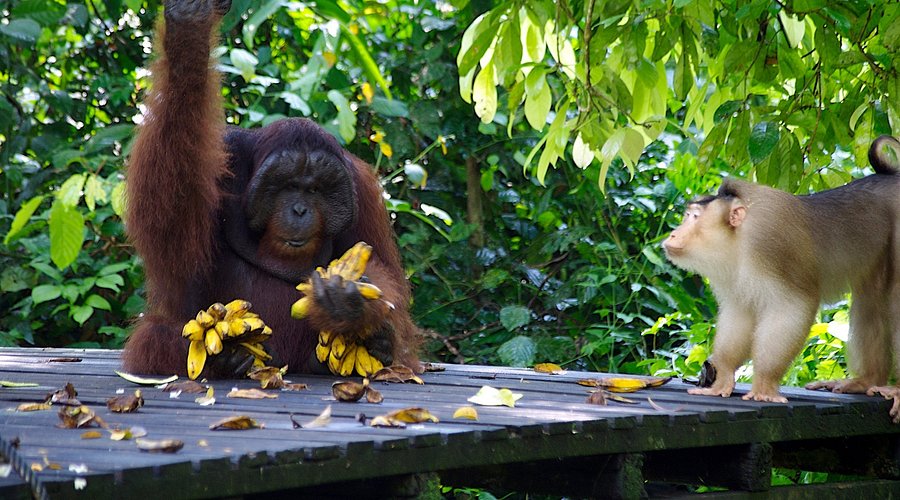
On a good morning she won't stay alone. Juveniles slip in along the side ropes like teenagers arriving late. Sometimes a second mother. And on the mornings people retell for years — a full flanged male. Face wide as a dinner plate. Shoulders that shouldn't be possible. Every other animal rearranges itself without him asking.
And always, the macaques. Darting in for scraps. Shrieking their small outrages. The orangutans ignore them the way kings ignore pigeons.
10:35
There's no ending. Nobody announces anything.
The food thins. The orangutans drift back up the ropes one by one — the mother last, her infant asleep against her. Then you're looking at an empty platform, and the macaques are doing the washing-up.
The forest takes its people back.
That's a feeding. Thirty to fifty minutes. Twice a day. Every day since 1964.
Now the mechanics.
The schedule — verified September 2026
- 10:00 — morning feeding. More orangutans in most months. More people too.
- 15:00 — afternoon feeding. Thinner crowd. A second roll of the dice on the same ticket.
- Gates: 09:00–12:00 and 14:00–16:00 daily. Friday mornings end at 11:00.
- One ticket covers both sessions. Feedings run every day of the year, rain or shine, holidays included.
- Lockers RM1. No bags or food past the entrance. Camera fee RM10, phones included.
Where to stand
The deck fills from the front rail backward. The rail is worth having — it's the difference between watching orangutans and watching the backs of people photographing orangutans.
July and August, be there by 09:15. The coaches arrive at quarter to ten. Shoulder months, 09:40 does it. At the 15:00 session, almost any arrival works.
One piece of local knowledge: the ends of the rail beat the middle. The middle faces the platform square-on and packs three deep. The ends look along the ropes — and the ropes are where the theatre happens. The arrivals. The departures. The slow trapeze of a mother with a passenger.
Bring less than you think. Your bag is in a locker anyway. Water, camera, both hands free. Macaques have taken sunglasses off distracted visitors, and once something goes up a tree here, it has emigrated.
Photographing it
No flash. Absolute rule, and rangers enforce it.
The light is dimmer than the tropics suggest. Raise the ISO, or trust your phone's steady mode. And be ready before ten — the arrival on the ropes is the photograph, and it doesn't repeat on request.
If the platform runs quiet, walk to the nursery. Closer. Glass-fronted. Always in session. That's where the frame-filling portraits live.
When it rains
It rains. This is rainforest — the clue is in the name.
Feedings run anyway, every day of the year. The deck is partly covered. A poncho beats an umbrella, which blocks six people's view and catches on everything.
The orangutans handle weather with visible disdain. Sometimes one holds a leaf overhead, like a commuter with a newspaper. Photographers learn to love the rain sessions: wet fur, silver light, empty rail.
Morning or afternoon
| 10:00 | 15:00 | |
|---|---|---|
| Orangutan turnout | Higher, most months | Lower, rarely empty |
| Crowd at the rail | Peak — coach hour | Thin |
| Light | Bright, dappled | Soft, dim, pre-rain |
| Pairs with | Nursery after, sun bears at noon | RDC canopy walk before |
Sleeping in Sepilok? Do both. The ticket's already paid, and two sessions doubles your odds on a quiet day.
Which months tilt the platform has a surprising answer — it involves the forest's fruiting calendar, and it flips the usual dry-season logic. The best time to visit.
The morning nobody comes
It happens. The rangers lay the food. The ropes stay slack. Ten minutes. Twenty. The macaques conclude the bananas are legally theirs.
Here's the reframe: you are watching the centre win.
Every orangutan not at this platform is feeding itself, out in four thousand hectares of forest. That is the entire sixty-year project, working in real time. The staff will tell you this with a straight face and mean it. The platform is designed to lose.
Your consolation prizes are good ones. The nursery is twenty metres away and never cancels. The 15:00 session is a fresh draw. And if orangutans are the whole reason you crossed the world, the Kinabatangan's wild ones are two hours east.
The full odds, unvarnished: are sightings guaranteed?
Feeding-time questions
How long does a feeding session last?
Food goes out on the hour. The session holds 30–50 minutes and tapers as the orangutans leave. Arrive early rather than stay late.
Can you attend both feedings on one ticket?
Yes — tickets are valid all day. Leave at the midday closure, return for 15:00.
Do feedings happen in the rain?
Every day of the year, all weather. Poncho over umbrella.
Which session has fewer people?
15:00, consistently. The coaches build around the morning and leave after lunch.
Is there feeding on Fridays?
Both sessions run, but the morning gate closes at 11:00 instead of noon. Arrive early, take the nursery first. Friday hours.