Can you hold an orangutan? No — and here's the whole answer
Updated Sept 2026 details verified
It's the question everyone Googles and almost no operator answers plainly, because 'no' doesn't sell. Here is the plain version: no contact at Sepilok, no exceptions, no VIP tier — and the three reasons are so strong that any place saying yes is telling on itself.
Reason one: your cold can kill them
Orangutans share roughly 97% of our DNA, and the family resemblance runs all the way down to the immune system's blind spots. Human respiratory infections cross to great apes with ease and land far harder — the sniffle you'd shrug off can hospitalise an orphan whose immune system is already carrying the stress of everything that brought it here. This is why the veterinary side of the centre runs on quarantine, why the nursery viewing happens through glass, and why the no-touching rule has no friendly exceptions. It isn't about you being unworthy. It's about you being contagious, which every human is.
Reason two: contact unteaches everything
The entire curriculum at Sepilok is one lesson taught a thousand ways: humans are irrelevant; the forest is home. A rehabilitating orangutan that learns humans dispense cuddles and snacks has just unlearned it — and an orangutan comfortable approaching humans is an orangutan that will one day approach the wrong ones, at a plantation edge, with consequences the rescue system exists to prevent. One generation of selfies can undo a decade of forest school. The centres that let you hug an ape are the centres whose apes will never leave.
Reason three: they are not gentle toys
A flanged adult male can weigh as much as a grown man, with an arm span past two metres and strength several times yours — these are animals that snap branches you couldn't bend, casually, one-handed. Even a juvenile's friendly grip is a vice. The distance rules protect the orangutans from your microbes and you from their affection, in that order of urgency but not by much.
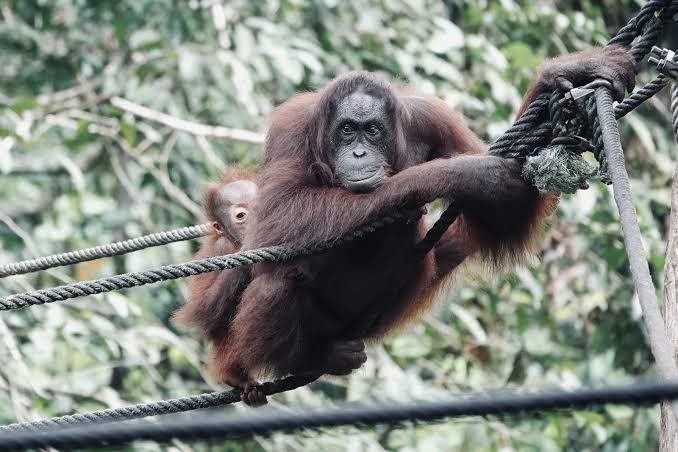
"But I've seen photos of people holding one…"
You have. Three explanations, none of them an invitation. Old photos: standards changed as the science did, and early-era rehabilitation worldwide allowed contact that no credible centre allows now. Other facilities: some places still sell contact — selfie sessions, "keeper for a day," feeding encounters — and that offer is itself the diagnostic: entertainment operations running against the animals' interests, whatever the word "sanctuary" on the signboard says. The two questions that sort them. Rogue guides: at trekking sites elsewhere, individual guides have baited orangutans close for tips — condemned by every responsible operator, and the reason to choose yours carefully wherever you go.
What happens if an orangutan approaches you
It happens at Sepilok — the free residents sometimes use the boardwalk's cables and rails as their own infrastructure, and one may amble past at arm's length. The protocol is simple: stop, back away calmly to give it the route, don't extend a hand, don't feed, and let the staff manage the moment. You'll be inches from a wild-living great ape making its own choices, which is a better story than any selfie — and it stays a good story only if you keep your hands to yourself.
What you can have instead
Everything that matters, honestly. Watch a nursery orphan fail at climbing and try again, through glass built to protect it, close enough to hear. Stand at the rail while a mother eats with an infant asleep on her hip. Fund one by name for years and get its progress reports — the only relationship on offer, and a genuinely good one. The connection you're after survives entirely intact at two metres. It's only the photograph that changes.
Contact questions
Is there anywhere ethical to hold an orangutan?
No. The disease and habituation problems travel with the species, not the venue. Anywhere offering contact has chosen revenue over the animals — the offer is the evidence.
Can volunteers at Sepilok touch the orangutans?
Less than anyone — volunteers work for the orangutans, rarely near them. What volunteering really involves.
What if an orangutan grabs my bag or camera?
Let go. Nothing you're carrying is worth a tug-of-war with an animal several times your strength — which is one more reason bags stay in the lockers and hands stay on cameras.
Can you feed the orangutans?
Never — not at the platform, not on the boardwalk. Feeding is the fastest way to unteach independence, and it's the rangers' job alone, twice a day, deliberately boringly. The full rules.