The rules, and why each one exists
Updated Sept 2026 details verified
Every rule at Sepilok protects the same thing: the orangutans' path back to the wild. Most sites list the rules. This page argues them — because a rule you understand is a rule you keep without a ranger watching.
The six written rules
1. Never touch an orangutan — even if it touches first
Two reasons, both absolute. Human diseases cross to orangutans easily and hit harder — your minor cold is their medical emergency. And a rehabilitating orangutan that learns humans are friendly has failed its most important class; the friendliness will one day walk it up to the wrong human at a plantation edge. If one approaches you on the boardwalk — it happens — back away calmly, give it the route, and let staff manage the moment. The full argument, including what you gain by keeping distance.
2. No food or bags past the lockers
Macaques treat bags as puzzles with prizes, and they're better at the puzzle than you are at the defence. Worse: every snack snatched teaches an animal that humans carry food, and taught once, that lesson escalates. The RM1 lockers at the entrance aren't bureaucracy — they're the centre removing the temptation at the gate, for everyone's sake. Water is fine to carry.
3. No flash photography
Flash startles wildlife at exactly the moment you wanted it relaxed — and the platform's light, though dimmer than the tropics suggest, is entirely workable without it. Raise the ISO, use your phone's steady mode, and read the photography notes for where the real shots live.
4. Quiet voices near the platform
The deck is the forest's edge, not a stadium. Noise doesn't endanger anyone — it just keeps the wildlife away, at your own expense. The hush that falls over the deck at 09:52 needs no enforcement; keep it.
5. Stay on the boardwalks and platforms
The reserve is the orangutans' home and release site — 4,294 hectares of it — and the paths are the visitors' entire share. Off-trail humans mean disturbed wildlife, trampled regeneration, and occasionally lost tourists, in ascending order of ranger paperwork.
6. Pay the camera fee
RM10 per device, phones included, rangers do check — and it funds the institution you came to admire. Pay it cheerfully; it's the cheapest wildlife photography permit on Earth.
The unwritten etiquette
Nothing below is enforced. All of it is noticed.
- At the rail: arrive early rather than push late. Phones up, not tablets — a raised iPad blocks four people's view for one person's mediocre footage. Lift children to the rail; they need it more than you do.
- Hold your possessions. Sunglasses, water bottles and phones held loosely have all emigrated into the canopy via macaque. Once it's up a tree, it's theirs.
- At the nursery glass: no tapping, no phone pressed to the window, voices down. The students can see you; the curriculum is that they learn not to care.
- When someone breaks a rule: tell a ranger rather than starting boardwalk diplomacy. That's what they're there for, and they're better at it.
- Drones: leave them at home. Wildlife reserves and drones don't mix, and nothing ends a peaceful feeding faster than something hovering over it.
The point of all of it
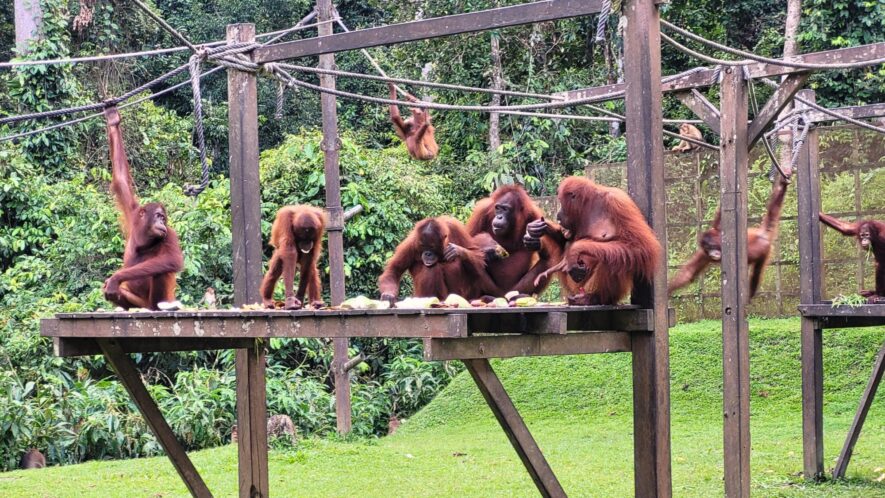
None of this restricts your visit — it is the visit. The distance, the hush, the locked-away snacks: you're watching a rehabilitation method in action, and the rules are its visible edge. The facilities elsewhere that let you hug an ape are the facilities whose apes will never leave. Sepilok's distance is the proof it's working.
Rules questions
What happens if you touch an orangutan by accident?
Tell a ranger immediately — the concern is disease exposure in both directions, and the staff will know what, if anything, needs doing. Accidents are why the rules manage distance so conservatively in the first place.
Can you bring a water bottle onto the boardwalk?
Yes — water is the exception. Food, drinks other than water, and bags stay in the lockers.
Are tripods allowed?
A small one won't raise eyebrows at a quiet session; at a crowded rail it's an obstruction, and courtesy beats equipment. No flash regardless.
Is there a dress code?
No formal one — just the practical kind. Muted colours, covered shoulders in deference to local norms, and shoes that grip wet timber. The full list.