The supporting cast
Updated Sept 2026 details verified
Everyone comes for the orangutans. The reserve, meanwhile, is running a full repertory company — gibbons on the dawn shift, hornbills at altitude, a night cast most visitors never meet. Here's the whole programme, with showtimes.
The dawn shift
Be anywhere in the reserve at first light and the Bornean gibbons own the airspace — whooping duets carrying kilometres, heard from every resort bed on the reserve road and seen by almost nobody, which is entirely in character. Dawn is also the birding hour: trogons, broadbills, kingfishers, and the early hornbill traffic commuting between fruiting trees.
The day cast, along the boardwalks
Long-tailed and pig-tailed macaques are guaranteed — the platform's uninvited regulars, the reason for every locker rule, and honestly half the entertainment. Red leaf monkeys flash maroon through the mid-canopy in small parties. Giant squirrels work the trunks like furry chainsaws; skinks and geckos hold the railings; and down where the reserve meets the bay's influence, mudskippers do their impossible thing on the mud.
The finding technique beats any checklist: stop walking. Five stationary minutes anywhere on the boardwalk out-produces an hour of striding — the forest resumes around stillness and simply routes around motion.
Overhead: the bird programme
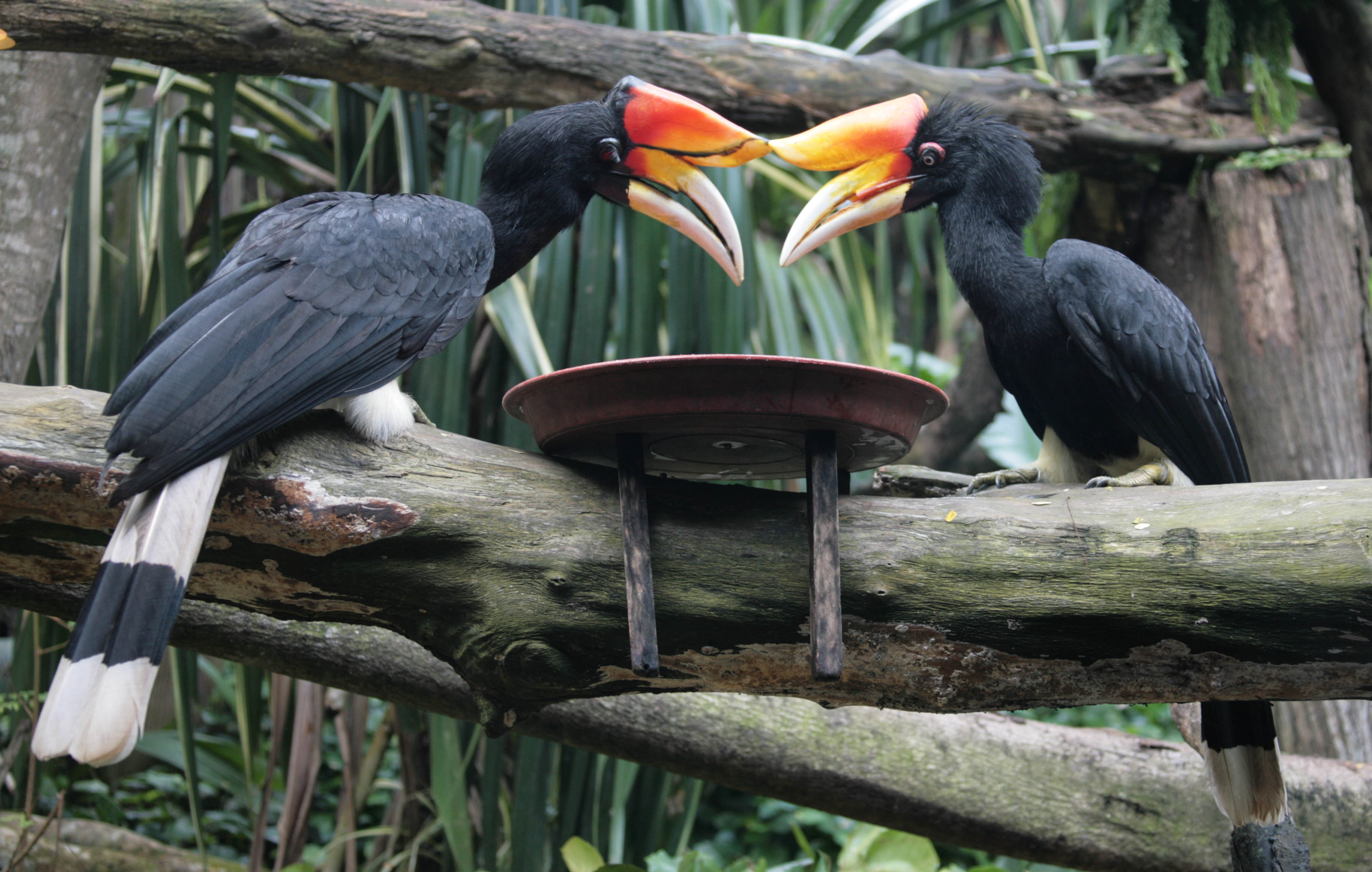
The reserve's Important Bird Area listing rests on 300+ recorded species, and the headliners deliver: oriental pied hornbills commonly, rhinoceros hornbills as the prize, plus the oddity that makes birders cross oceans — the Bornean bristlehead, best sought from the RDC's towers and 347-metre canopy walkway, where you stand at hornbill height instead of craning at it.
The night shift
At 18:00 the programme flips, and the night walk is your ticket: red giant flying squirrels launching from the towers at dusk — a house-cat-sized square of fur gliding fifty silent metres — then the torchbeam cast: slow lorises moving like poured honey, civets as paired orange coins, kingfishers asleep a metre from your face, stick insects at implausible scale. And the reserve's rarest card, the Western tarsier — all eyes, gripping a sapling like a startled gargoyle — sighted rarely enough to make a guide's month.
The neighbours' specialists
Two more casts sit on the same road: the sun bears across from the orangutan gate — the world's smallest bear, forty-plus rescued individuals, best watched mid-morning before the heat-drowse — and the RDC's full canopy ecosystem. One road, arguably Borneo's densest wildlife address. The day that collects it all.
What you won't see
Setting honest expectations: pygmy elephants belong to the Kinabatangan, not the reserve; clouded leopards exist in Borneo's deep forests and in essentially nobody's holiday photos; and proboscis monkeys hold court on the river, not here. The reserve's genius is density of the findable, not a checklist of the mythical.
Wildlife questions
What animals will I definitely see at Sepilok?
Macaques, without fail; skinks, squirrels and good birds with minimal effort; orangutans at the nursery near-reliably. Everything else scales with stillness and hours.
Can you see proboscis monkeys at Sepilok?
No — they're riverine specialists. Two hours east, the Kinabatangan serves them by the treeful at dusk; Labuk Bay's sanctuary sits nearer Sandakan for a managed version.
Is Sepilok good for birdwatching?
Genuinely — the IBA listing, 300+ species, and the RDC's canopy-height infrastructure make it a birding destination in its own right, bristlehead included.
What's the rarest animal in the reserve?
By sighting frequency: the tarsier, with the bristlehead as the birders' equivalent. Both are night-walk and towers material respectively — and both are why guides here stay excited after decades.