How rehabilitation actually works
Updated Sept 2026 details verified
Rescue. Recover. Unlearn humans. Learn the forest. Leave. Five stages, years per orangutan — and a curriculum whose final exam is passed by not showing up.
Stage one: arrival
They come in from the wreckage of the forest economy: orphans of logging and plantation clearing, confiscations from the pet trade, casualties of conflict at the forest edge where a mother raiding crops was killed and her infant collected from the aftermath. Why the intake never stops.
Most arrive young, many malnourished, some having never climbed a real tree — a pet-trade orangutan may know television better than canopy. Each arrival carries the same deficit: the seven-to-eight-year education a mother would have provided, missing, and needing a substitute.
Stage two: the clinic
Before anything else, medicine. Health checks, disease screening, treatment, and strict quarantine — because human diseases cross to orangutans easily and an intake ward is exactly where they'd spread. This is the invisible Sepilok, behind the public areas: the veterinary clinic and treatment ward where rehabilitation begins as simple survival. It's also where the centre's obsession with distance is born — the same disease logic that runs the quarantine runs the no-contact rule out on the boardwalk.
Stage three: the buddy system
Here's the method's quiet masterstroke: the keepers try to make themselves replaceable from day one. Young orphans are paired and grouped — not just for company, but because an orangutan is a far better orangutan teacher than any human. They copy each other's climbing, test each other's nerve, squabble over ropes, and in doing so build the social confidence and physical vocabulary a mother would have modelled. The keepers provide care, milk and safety; the buddies provide the education.
Stage four: forest school
The outdoor nursery is this stage made visible: the climbing frame at the forest edge where grip, judgement and nerve get built, fall by netted fall. The skills list is longer than it looks from the viewing room — route-finding through a canopy, telling food from foliage, building the fresh sleeping nest a wild orangutan makes most nights. Every skill has to move from lesson to reflex before the forest will grade it kindly.
Stage five: the loosening net
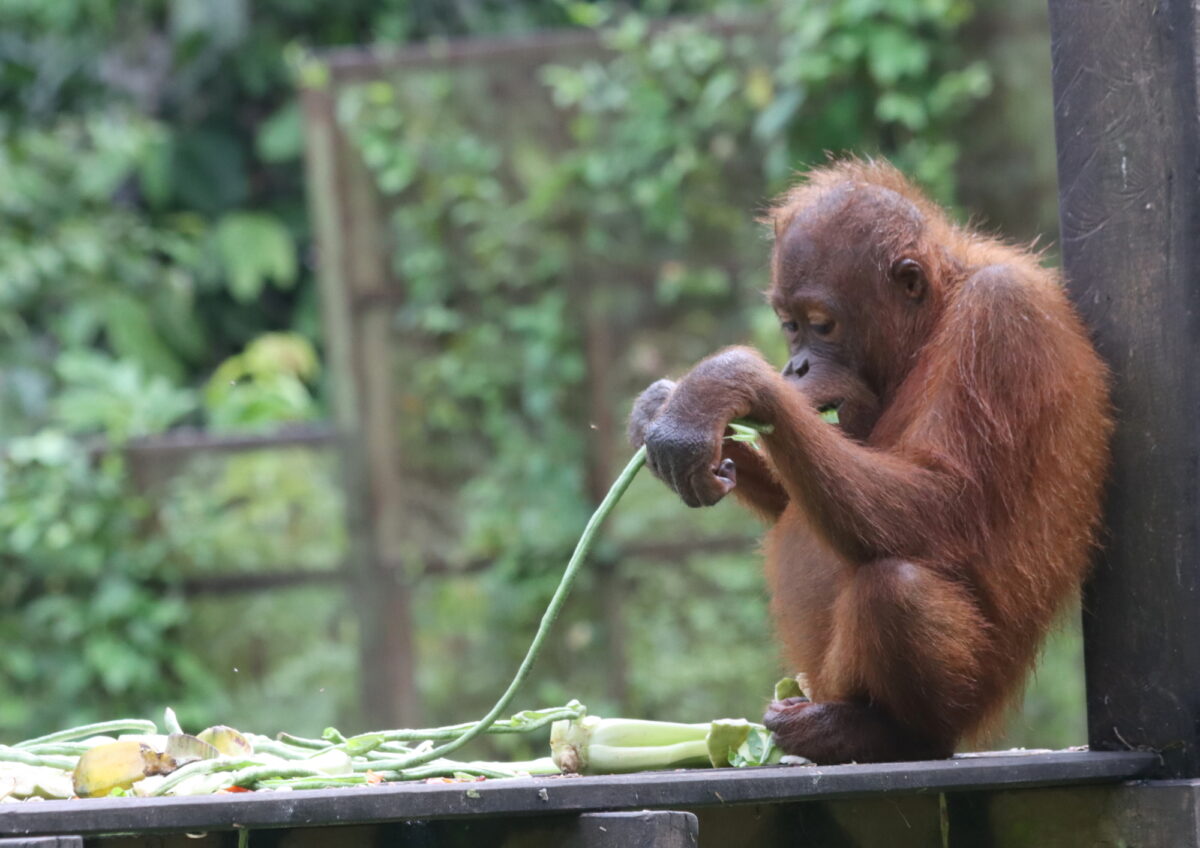
Graduates move into the reserve itself — free to roam the 4,294 hectares, but able to fall back on the feeding platform's unchanging milk-and-bananas. The menu's dullness is the mechanism: nutrition without temptation, a safety net engineered to be outgrown. Attendance thins as competence grows — first skipping the odd session, then weeks, then seasons. Why the empty platform is the system working.
The graduation nobody attends
There's no ceremony. An orangutan simply stops coming, and its absence is the diploma. Some veterans reappear occasionally for years, casual alumni. And the highest honour the centre knows arrives unannounced: a female, gone for seasons, at the forest edge with a wild-born infant on her hip — not needing the safety net, showing her baby where it is anyway, the way her keepers once showed her.
Why it takes years — and why the numbers are big, not small
A wild orangutan gets its education across the longest childhood of almost any animal. Rehabilitation must compress a substitute for that into a program run by humans whose success requires teaching their own irrelevance. Years per orangutan is not inefficiency; it's the size of the task. Against that measure, one hundred-plus releases and 60–80 free-living graduates is not a modest return — it's six decades of the hardest kind of teaching, working. How the method was learned.
Process questions
How long does orangutan rehabilitation take?
Years — often most of a decade, mirroring the seven-to-eight-year childhood a mother would have provided. Speed isn't the goal; irreversibility is.
What do the orphans eat during rehabilitation?
Milk and appropriate foods in the nurseries; at the platform stage, the famously monotonous milk-and-bananas — deliberately dull so the forest's menu always wins.
Do rehabilitated orangutans survive in the wild?
The reserve's 60–80 free residents are the living answer — including females raising wild-born young, the outcome the whole pipeline points at.
Can visitors see every stage?
No — the clinic and indoor nurseries are off-limits for quarantine and welfare. Visitors see forest school (the nursery) and the loosening net (the platform): the middle and the end of the story.