Sixty years of Sepilok
Updated Sept 2026 details verified
In 1964, nobody knew whether an orphaned orangutan could be taught to be wild again. The answer took a forest reserve nobody had planned for the purpose, one determined conservationist, and six decades of patient revision. Here's how it happened.
1931 — the forest comes first
The story starts before anyone in it was thinking about orangutans. In 1931, colonial-era foresters gazetted the Kabili-Sepilok Forest Reserve — 4,294 hectares of lowland rainforest running down to the mangroves of Sandakan Bay, protected initially for forestry research.
Nobody involved could know they were setting aside the one thing a rehabilitation centre cannot be built without: a protected forest to release into. Every graduate since owes its freedom partly to a decision made three decades early, for other reasons entirely. The reserve today.
1964 — the experiment
By the early sixties, Sabah's logging boom and the pet trade were producing a steady stream of orphaned orangutans, and no playbook existed for what to do with them. Conservationist Barbara Harrisson had been confronting the problem directly — raising confiscated orphans and asking the question nobody had answered: could a hand-reared orangutan be returned to the forest at all?
Sepilok, founded in 1964 under Sabah's Forestry Department and later the Wildlife Department, was the world's first official attempt at an answer. The premise was radical for its time: not a zoo, not a shelter, but a school — an institution whose success would be measured by how completely its residents left.
The decades of revision
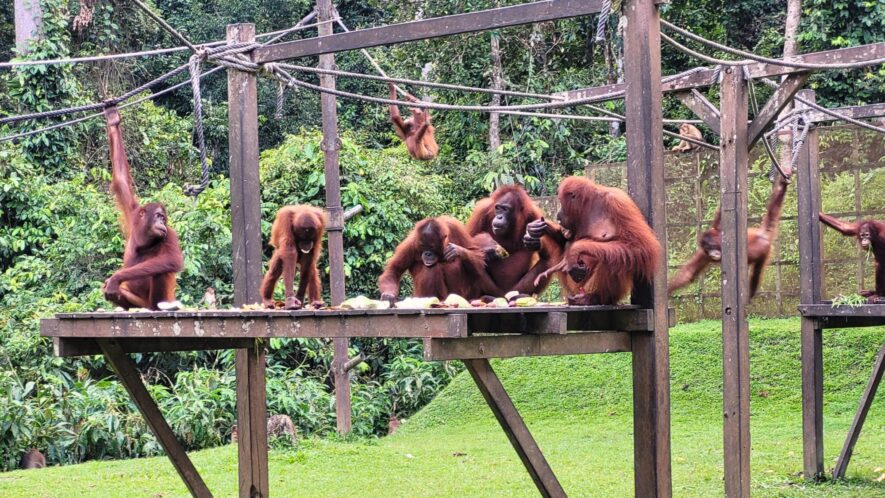
The method wasn't born finished; it was debugged. Early rehabilitation everywhere allowed far more human contact than the science would later permit, and Sepilok's decades were spent learning — sometimes hard — what actually produced wild orangutans rather than tame ones. The lessons calcified into the system a visitor sees today: staged care from clinic to nursery to forest; orphans paired to learn from each other rather than from keepers; the platform's deliberately boring menu; and the no-contact rule hardening from guideline into law as the disease evidence mounted.
The numbers accumulated quietly alongside: more than one hundred orangutans released across the decades, with 60–80 living free in the reserve today and around 25 orphans in the pipeline at any time.
2001 — the partnership era
In 2001, Orangutan Appeal UK began funding rehabilitation and care work at Sepilok — a partnership that continues today and runs the official adoption scheme, connecting the centre's patient, unglamorous daily work to supporters worldwide.
2008 — the model exports itself
The clearest tribute to the method arrived across the road: the Bornean Sun Bear Conservation Centre, founded in 2008 by Wong Siew Te explicitly to do for the world's smallest bears what Sepilok had shown was possible for its most famous ape. One road, two rehabilitation centres, one idea.
2014 — the window opens
The outdoor nursery's opening in 2014 changed what a visit could mean: for the first time, the public could watch the education itself — the climbing, the falling, the trying again — rather than only its graduates at the platform. It remains the emotional centre of most visits.
The camera years
Along the way the centre became one of conservation's most filmed addresses — Paul O'Grady's "Animal Orphans", Animal Planet's "Meet the Orangutans", "Among the Great Apes with Michelle Yeoh" — each production carrying the same sixty-year-old premise to a new audience: teach them the forest, then give it back to them.
That premise hasn't needed updating since 1964. Everything else — the science, the rules, the buildings — has been revised around it. How the method works today.
History questions
Who founded the Sepilok orangutan centre?
Conservationist Barbara Harrisson, in 1964, under Sabah's government — the world's first official orangutan rehabilitation project. It's run today by the Sabah Wildlife Department.
Why was Sepilok chosen as the site?
The Kabili-Sepilok Forest Reserve — protected since 1931 — offered what rehabilitation needs most: intact forest, already safeguarded, to release into.
How many orangutans has Sepilok released?
More than one hundred across six decades, with 60–80 living free in the reserve today. The numbers, sourced.
Is Sepilok the oldest orangutan sanctuary in the world?
The oldest official rehabilitation centre, yes — 1964, before any comparable facility. Its model shaped most of what came after, sun bears included.